Category Archives: Instant Photography

20×24 Studio Berlin, meet the people behind the camera

20×24 Studio Berlin

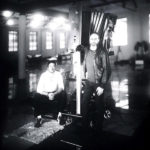
Interviews with the principals behind the opening of the 20×24 Studio Berlin, Florian Kaps, Markus Mahla, and Oliver Blohm. Filmed in Berlin in July of 2018 during the opening of the “Polaroid Project” exhibit at the C/O Berlin.

Interviews with the principals behind the opening of the 20×24 Studio Berlin, Florian Kaps, Markus Mahla, and Oliver Blohm. Filmed in Berlin in July of 2018 during the opening of the “Polaroid Project” exhibit at the C/O Berlin.

Camera Ready: Journeys with the Giant Polaroid

Camera Ready: Journeys with the Giant Polaroid is a documentary film in progress chronicling the legendary 20×24 camera and the artists how used it as well as the people who created it.  The film was begun in 2014 with early interviews with William Wegman, Elsa Dorfman, and Chuck Close.  As time has passed the studio continues, now in its 10th year after exiting Polaroid.  Work on the documentary continues as the story is still unfolding and new possibilities emerge with a re-born European studio in Berlin and renewed interest in the US studio in New York.  This 5 minute cut gives you a sense of the history and the stories behind the amazing project that is the Polaroid 20×24 Studio.

Camera Ready: Journeys with the Giant Polaroid

It is always a challenge to distill a full film into a trailer or five minute summation. In this edit I wanted to show both the artists and Polaroid individuals who are key to the story. I chose longer passages of fewer subjects rather than several second snapshots of more people.

20×24 Studio Berlin Opens

We are very excited to announce that a new 20×24 Studio has opened in Berlin, Germany.  It is run by Markus Mahla and Oliver Blohm.  Here is an excerpt from an interview with Mahla in The Phoblographer.

Markus Mahla: 20×24 Studio Berlin is a one-of-a-kind place that brings one of the most unique cameras of the last century back to life: the 20×24 Polaroid Land Camera. Polaroid built only five of these cameras in the 1970s. At our new location in the heart of Berlin, we present the beautiful number 5. It is the only operating 20×24 Land Camera outside the US. Number 2 is with John Reuter in NYC, and Number 3 is with Elsa Dorfman in Boston Area. What we do is pretty special: we produce mega format instant photography.

“I observed over the past years (and I was part of digital transitions in several companies with large and strong brands) that the more ‘digital’ young folks get or are, the more they are also very much interested in analogue experiences, such as taking a Polaroid picture. A process that you can touch, feel, smell, see, hear.”

What all groups, clients and partners have in common is that they adore what we do. The 20×24 inch size is simply overwhelming; it gives you goosebumps and makes you overjoyed. I have never seen anybody who was not blissfully happy about his image and people who watch and follow the photography process are enthusiastic. This process was and is magic and attracts everyone in its spell. Taking a single photograph is an event in itself but, peeling this huge image apart in front of an audience, literally a minute after pulling it out of the huge camera, is a ball. People are moaning, applauding, screaming, they get goosebumps – we had folks who were in tears when their portrait was peeled off. It’s always a very special moment. Even me being around this wonderful peace of art for quite a while, I’m getting excited while I tell all this to you.

Wherever we go, the 20×24 Land Camera is an eye-catcher. People are super excited – it feels to me that they are even more excited compared to the past since this is such an unexpected surprise. The wooden camera and the way we operate looks like were from a Jules Verne novel. Hardly anybody can actually believe that something like this really exists in our digital world. It is spectacular.


Jeff Enlow: Parallelograms

andromeda 7In 2013 artist Jeff Enlow approached the 20×24 Studio with the idea to expand his project “Parallelograms” to the 20×24 format. Jeff had been working for some time in 4×5 format and dreamed of scaling it up to the pinnacle of the large format instant experience. After a half day test session to be sure it would work Jeff embarked on a Kickstarter campaign to fund further shooting sessions. This was the first Kickstarter we know of to underwrite a 20×24 project and the response was enthusiastic. With the Kickstarter proceeds Jeff was able to fund several more sessions, completing his vision for the Parallelograms series with a flourish.

ParallelogramsParallelogramsParallelogramsParallelogramsParallelograms


Behind the scenes photos by Bryan Derballa.

Jeff writes of his experiences with the 20×24:

I first discovered the 20×24 as a young student flipping through an American Photo Magazine. There was a small feature on the camera at Sundance. I remember being amazed by the size and weight of the camera. I always loved instant film but this was something else all together. At that time in my life using the 20×24 camera was well beyond my means or skill level. I stored the idea in the back of my mind till I had a project that called for the camera.

When I first conceived of Parallelograms, central to the project was that the images had to feel physical. I wanted to make an image that felt more like making a painting. There is a certain draw to seeing an original one of a kind painting in a museum or gallery that I felt is lacking in photography. Shooting on instant film became the bridge between those two mediums.

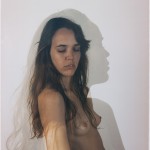
Visually, Parallelograms is a study of the topography of the human body. Multiple exposures allow the eye to wander in and out of the intersecting and diverging hills and valleys of the human figure. The unexpected shapes that are revealed in the merging of the two exposures is a wholly new creation—a sacred third entity—that exists in no other plane but on that single instant film sheet.

I start with a general sketch of an image in my head and first shoot it on 4×5 Fuji pack film.  I collaborate with the model and decide the basic structure and flow I am looking for. From there, there are lots of micro adjustments like “drop your chin down, pull this arm back, hide that piece of hair;” I shoot one exposure, then we reset and do it all again. I mark on the ground glass the outline of the first image; so that when we shoot the second image I can try and guide it to flow well.  I can steer the image in the direction I want, but the final print has a gestalt that is beyond omniscience.

There is a bit of translation that happens between shooting on the 4×5 and the 20×24. Using a medium as big as the 20×24 I had to rethink my relationship with both the model and the camera. I couldn’t just show up and reshoot my existing 4×5 images. I have a greater level of flexibility in the smaller 4×5 camera. I can push the camera into different positions and angles that aren’t possible when you are working with a camera a 1000 times larger.

Despite having this massive impedance between the model and myself I was able to achieve an intimacy on the 20x24s that I hadn’t reached before. The intense detail captured transforms the photos into truly rich character studies. It takes a lot of bravery for a model to stand nude in front of the camera. There is little you can hide from a 20×24 Polaroid, every freckle, blemish, and hair is exposed and enlarged.

Using the 20×24 forced me to dramatically slow down. Because of the size and complexity of the camera, along with the rarity and cost of film I only shot 10 – 12 images in a day. This makes little room for error, but also makes for an interesting and nuanced edit of the images. Additional versions of the same image are presented next to one another to highlight the subtle shifts that happen while shooting.

Working with the 20×24 Polaroid creates a craftsmanship to each image that elevates the photo beyond just the culmination of pigments in emulsion. Like brushstrokes on a canvas, subtle details reveal the hidden history of each image. The temperature and humidity in the room, the age of the film and camera, the motion of how the emulsion is pulled—all these elements combine to make a final image that has a visual language and personality unique to itself.